Bougainville Education News :Book-Gain-Ville boosts access to books with e-reader project

251-book-gain-ville

“The kindles has changed the lives of our teachers and students forever “

James Tanis Ex-President of Bougainville and founder of Narinai Elementary School in the Panguna District.

Book-Gain-Ville boosts access to literature with e-reader project

Originally published http://www.bougainville24.com/

Our thanks to Leonard Fong Roka for support and promotion of Bookgainville

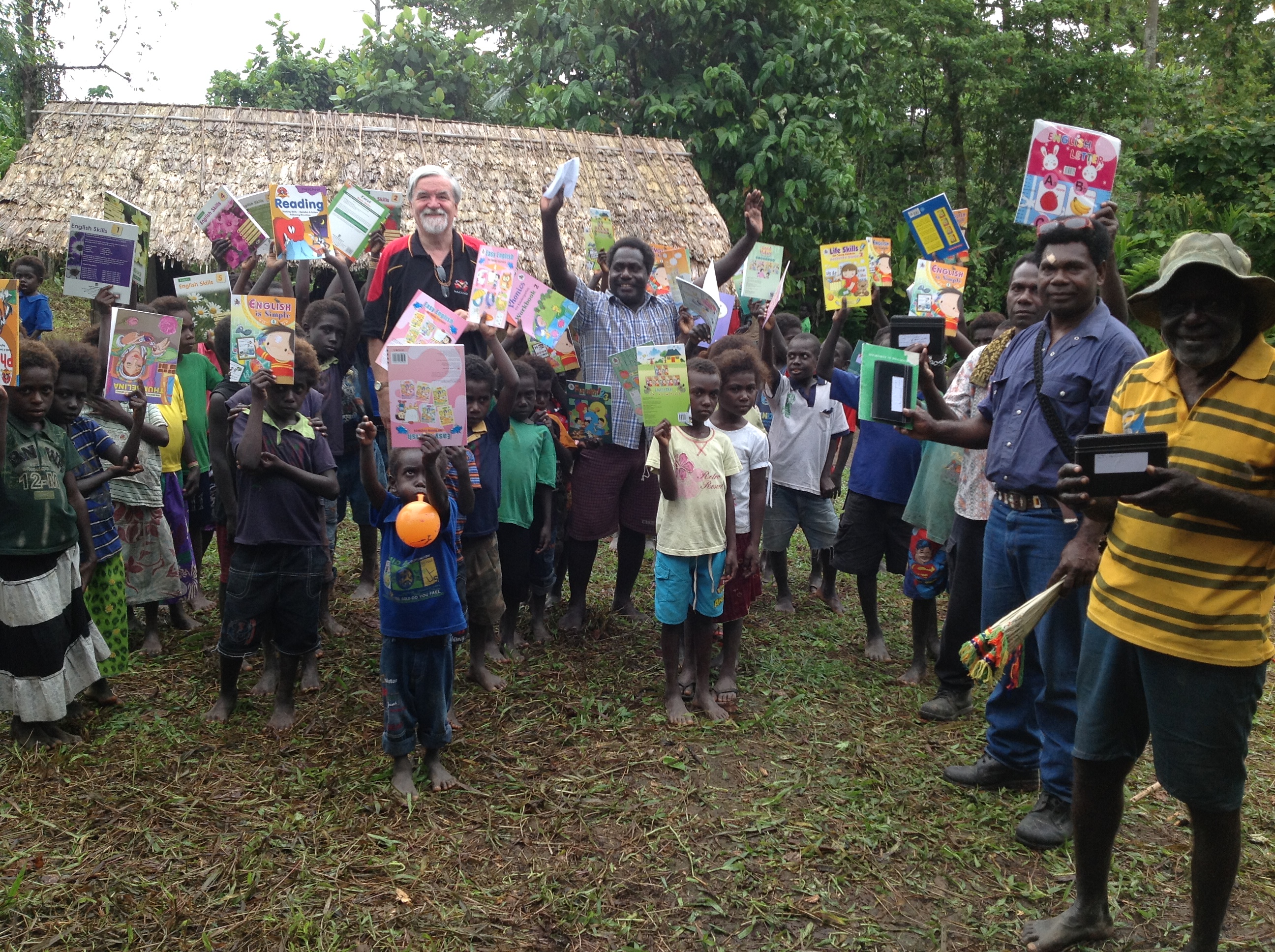
An Australian man, so affected by a trip to bring e-readers to students in a remote Panguna village, has launched an initiative to improve literacy throughout Bougainville.

Colin Cowell started the Book-Gain-Ville project in Australia with the support and guidance of the Indigenous Reading Project.

Cowell’s original visit with 20 kindles was to the Narinai Elementary School in the Panguna District, the home of former Bougainville president Mr. James Tanis. Here the Book-Gain-Ville project was launched and welcomed to the community with dancing, singing, speeches and slaughtering of two pigs to mark the importance of the occasion.

“Travelling around I saw broader need across the whole island, so we have added ten more sites for trial of the Book-Gain-Ville initiative,” Mr Cowell said.

“By the end of June 2014 we hope to have over fifty kindles in ten pilot schools and over the next few years I would like to see over one thousand kindles in Bougainville schools with the support of all the local level governments.”

Cowell, who hails from Canberra, Australia, has 24 years of experience working with and training Aboriginal communities across Australia and stated that the key to the Book-Gain-Ville project is sustainability.

251-colin-cowell

“We now have in place at the Arawa Women’s Training Centre the support technology and trained staff to take this project forward in years to come,” Cowell said.

“Guiding this project on the ground is a leadership group lead by James Tanis and group of teachers and IT volunteers.”

“The Kindles with up to 1400 books inside cost $99.00 and a lot of communities including the pilot sites have already begun fundraising to buy extra kindle on top of our donations.”

Update 11 July 2014

We are packing another 40 Kindles in Canberra to send to Bougainville on Monday 14 July

kindles

Colin Cowell is no stranger to Bougainville having lived there some 40 years ago and return he spent the whole month of May travelling the length and breadth of the island.

He met his old friends like Linus kunokong from Buin and visited cultural shows in Siwai, South Bougainville; visited tourism development sites across the island and even participated in the Bougainville Remembrance Day, May 17, in Arawa.

He will be returning soon to Bougainville with more kindles In September after shipping in July (see above)

More information about the project is available at www.bookgainville.com


Bookgainville  Project on Bougainville PNG


Bougainville News: Bougainville Government radically structures its government ministries to meet current and future needs.


43-parliament-house

Reported by Anthony Kaybing New Dawn FM Bougainville News

The Bougainville Executive Council has made the decision to radically structure its government ministries to meet its current and future needs.

This follows the establishment of the Autonomous Bougainville Government’s own Public Service that now operates under its own law within Bougainville.

Kabu House


ABG President Chief Dr John Momis made the revelation during the Joint Supervisory Body Meeting between the ABG delegation headed by President Momis and the National Government delegation headed by the Deputy Prime Minister, Hon. Leo Dion, in Kokopo, East New Britain Province this Friday (040714).

“This is the first restructure of the Bougainville Government Ministries and the Administration since 2005 and the number of ministries has been cut to 15, thirteen members of the Cabinet will have only one ministry, and only one minister will have two ministries.

This will enable all Ministers to focus their efforts on one government priority area,” the President declared.

With the new structure in place the ABG Ministries will now be as follows;

  1. Presidential portfolios:
  2. Administrative Services
  3. Treasury & Finance
  4. Justice
  5. Police and Corrections
  6. Mineral Resources & Energy
  7. Technical Services
  8. Lands & Physical Planning and Environment & Conservation
  9. Health
  10. Education
  11. Community Government
  12. Communities, Women, Youth and Culture
  13. Sport and Youth
  14. Primary Industry
  15. Commerce and Tourism.

The Bougainville Senior Appointments Committee (BSAC) will be responsible for the appointment of the Chief Secretary (formerly the Chief Administrator) and Head of the Public Service and Senior officers including departmental heads.

The Acting Chief Secretary will work with each minister to prepare a recommendation to the Bougainville Senior Appointments Committee for an Acting appointment for each department and directorate and all permanent appointments will be made within six months to start from 1 January 2015.

“The ABG has already taken practical steps to implement these new ministerial arranges that enforces the new Bougainville Public Service Act,” he said

The President also said that there were to be two new Ministries that will be created that sees the creation of a Ministry and Department of Police and Correctional and the Ministry and Office of Sports and Youth.

President Momis went on to reveal that the Bougainville Administration will have 11 departments headed by Secretaries and four Offices headed by Directors who will be the equivalent to a secretary of a department.


join-1

YOU CAN NOW SUBSCRIBE TO BOUGAINVILLE NEWS CLICK HERE

Bougainville News: Does the PNG Government currently owe the Autonomous Bougainville Government over K200 million ?

PM PNG
 

“The PNG government will continue to honour its commitment in releasing K100 million annually for the remaining four years.

The national government in 2012 made a commitment to allocate K500 million over a five-year period, to rehabilitate infrastructure throughout Bougainville.

However, despite the first K100 million funding being released, last year (2013), nothing much has been done there,”

PNG Prime Minister Hon. Peter O’Neill said in a recent radio interview (see below)(picture above traditional welcome to Bougainville February 2014)

The Papua New Guinea National Government currently owes the Autonomous Bougainville Government over K200 million under the Restoration Development Grants.

This was revealed this week (30 June 2014) by the ABG president Chief Dr John Momis during the opening of a double classroom at Tilowa Primary School when he was talking about the transfer of powers to the Council of Elders

He told the people who gathered for that special occasion that this money under the Bougainville Peace Agreement belongs to Bougainville but the National Government was underpaying us.

He said after calculations were made, ABG found out that the National Government owes us over K200 million.

The president said if ABG gets that money, they will then look at ways to help the Council of Elders

in terms of increasing their funds.

He explained that in this way, the Council of Elders will be empowered to look after their own law and order issues, education

Prime Minister Peter O’Neill today (6/02/14) expressed the National Government’s gratitude towards the leaders and people of Bougainville for their kind welcome and generous hospitality, during his delegation’s recent visit to the region.

He said this during an interview on the FM100 Talkback Show, in Port Moresby and outlined the government’s commitment to assist Bougainville with infrastructure rehabilitation funding.

“The government will continue to honour its commitment in releasing K100 million annually for the remaining four years.

“The national government in 2012 made a commitment to allocate K500 million over a five-year period, to rehabilitate infrastructure throughout Bougainville.

“However, despite the first K100 million funding being released, last year (2013), nothing much has been done there,” Prime Minister Hon. Peter O’Neill said.

The Prime Minister said the monetary allocation was committed entirely to rehabilitate the rundown infrastructure throughout the region.

He also said the funding allocated last year was given to the Autonomous Bougainville Government (ABG) and it is solely responsible for acquitting the funds.

“There are also Special Resolution Grants sitting in trust accounts that need to be spent on upgrading infrastructure there,” Prime Minister Hon. Peter O’Neill said.

He said with the history of the crisis and loss of lives it was important for the national government to go back and engage with the people of Bougainville and apologize traditionally for all the hardship created, not only for Bougainville but for PNG as well. “I believe these issues could have been better managed before it got out of hand.

“It has been an eye-opening experience for a national government delegation which I led into the region recently,” Prime Minister O’Neill said.

He thanked the ABG, particularly President Chief Dr John Momis and his Cabinet, along with the four MPs of Bougainville for their partnership and dedication in putting aside their differences and working together to move Bougainville forward.

“I also met with the President of the Me’ekamui Government, Philip Miriori, and other leaders including the Panguna landowners like Laurence Daveona and Sam Kaona,” Prime Minister O’Neill said.

The Prime Minister reiterated that the government still respects the Arawa Peace Agreement signed in 2001 and looks forward to implementing it. “Our aim of going to Bougainville was to try and restore government services in the region.

“We want our hospitals to be functioning well in Bougainville, the roads upgraded and sealed, and the Aropa Airport reopened,” the Prime Minister said.

“The government has already opened the Port in Kieta and has re-established PNG Power to distribute power throughout Arawa town,” Prime Minister Hon. Peter O’Neill announced.

The president of the autonomous Papua New Guinea province of Bougainville, John Momis, says his government is considering suing the national government for what he says is its failure to meet the terms of the Peace Agreement.(Interview July 2013)

He says the lack of money is stalling preparations for the referendum on possible independence, which is a key part of the Bougainville Peace Agreement.

That vote is likely in 2016 and Mr Momis told Don Wiseman Bougainvilleans need to be more self reliant or seek financial help elsewhere if the national government does not meet its commitments.

JOHN MOMIS: The people of Bougainville must realise that that event, that important political moment in the history of Bougainville is quite imminent. As a matter of fact, next year the ABG, their own house of representatives, will determine the actual date of the referendum. So whilst we’re experiencing a lot of problems in respect to assistance from the national government, we need to get ourselves organised and be more self-reliant, even in terms of sourcing funds from outside. Because we are not having a very successful engagement with the national government. They seem to be having no qualms or conscience and consistently breaching the Bougainville Peace Agreement. So the only way to motivate our people is to say, look, we have to be ready. It’s like saying the grand final date is on, and, whether we are ready or not, we have to play in the grand final. We made the commitment so we better get ourselves organised.

DON WISEMAN: When you say that the national government is breaching the peace agreement, there was a lot of good feeling toward the end of last year and the government came through with those very large commitments they had made. So are you suggesting there’s been a backtracking since then?

JM: There’s been quite a bit of backtracking, yes. Even last year the $100 million the government promised only came to us in November towards the end of the year. It doesn’t give us much time to implement, especially when the Bougainville administration doesn’t have the capacity. And this year, we haven’t go this year’s allocation yet. And the restoration and development grant, which is stipulated in the Bougainville Peace Agreement, which is sub-constitutionally guaranteeing the allocation of funds which should be given to us every year – they have been under paying us deliberately. We worked out that, in fact, the national government owes us something like approximately $188 million. That is the only guaranteed funding to Bougainville. They’ve been severely underpaying us.

DW: And that’s separate from the commitment of 500 million kina that was made?

JM: Yes, 500 million for the next five years – that’s a political commitment the national government made. Whereas the restoration and development grant is constitutionally stipulated. The national government has no choice but to give it. In fact, we are seriously thinking of taking them to court for such a massive breach, which creates a lot of doubt in the minds of Bougainvilleans about the national government’s goodwill


Bougainville NEWS: Environment group offers $9m for biodiversity projects

 
Solomon Island farmers
Photo: Solomon Islands has some of the best examples of biodiversity in the Pacific (Wade Fairley: Flickr)
An environmental group is offering $US9 million in grants to help non-government organisations fund projects in Solomon Islands, Vanuatu and Papua New Guinea.
map_of_emi_1_141513

The International Union for Conservation of Nature says it wants to fund work that will protect biodiversity in the region.

The CEPF investment strategy for the East Melanesian Islands Hotspot has five strategic directions:

  1. Empower local communities to protect and manage globally significant biodiversity at priority key biodiversity areas underserved by current conservation efforts.
  2. Integrate biodiversity conservation into local land-use and development planning.
  3. Safeguard priority globally threatened species by addressing major threats and information gaps.
  4. Increase local, national and regional capacity to conserve biodiversity through catalyzing civil society partnerships.
  5. Provide strategic leadership and effective coordination of conservation investment through a regional implementation team

HOW TO APPLY LINK HERE

The IUCN’s Luisa Tagicakibau says there are countless habitats that need protecting and is calling for groups to submit proposals.

“These islands are highly biodiverse and hold exceptional cultural and linguistic diversity,” she told Pacific Beat.

“There are so many threats to these biodiversities, which are human induced and include increasing population, lack of awareness, unsustainable economic development.”

The IUCN is targeting 20 key biodiversity areas covering 1.5 million hectares.

“There are so many cultural and linguistic diversities at play in this region and because only a few people are speaking certain languages, they’re fast disappearing,” Ms Tagicakibau said.

“And that’s often leading to an increasing erosion of traditional knowledge and practices. These people are the real stewards of biodiversity.”

The money is being provided by the Critical Ecosystem Partnership Fund, which is a collaboration of seven different bodies including the European Union, the Japanese and French governments and the World Bank.

The IUCN says groups have until August 26 to submit proposals for funding.

Keep in touch with Bougainville

and funding opportunities SUBCRIBE FOR FREE

join-1

BOUGAINVILLE NEWS LINK


Bougainville Education News: Bougainville teachers receive TOT training


Book Gain Ville School

 Bougainville school at Narinia Nagovesi SEE LINK

FROM PNG EDUCATION NEWS

THE Bougainville Education Department, in its effort to make schools have their own Behavioral Management Policy (SBMP), has undertaken the task of training teachers to document their own policies.

The Department has already given Training of Trainers (TOT) to elementary and primary school head teachers, their board of management chairman’s and village chiefs of Selau and Suir constituencies in North Bougainville.

The policy is to act as a guideline to promote a caring, safe and healthy environment for the purpose of improving students learning inside the school and within the community.

Last week saw another TOT training being conducted at Tekokni primary school in Suir which was attended by 43 participants from the area.

The training was facilitated by Education Standard Officer, Mr Felix Sarimu, Guidance officer, Josephine Passingan and District Education Officer Mr. Ignatius Veromboe.

Mrs Passingan said the purpose of involving the chiefs, BOM and teachers is because there is a need for wider consultation to document the SBMP.

Acting Secretary of Bougainville Education Department, Mr Michael Meten, who attended the closing of the workshop last Thursday said the same problems that a child has in school is also being faced in the community.

“With the increase in number of students because of the tuition fee free education by the O’Neill/Dion Government, teachers now have a big responsibility to deal with,’ he said.

“Family problems also affects the child and teachers and the BOM must need to deal with that particular child and they must also deal with bullying, alcohol, smoking and chewing of betelnut in bigger students.’’

Mr Meten pointed out that every school needs to develop a policy to guide behavior in school and to help create a conducive environment for students, before adding that the policy will now be part of the Schools Learning Improvement (SLIP).

This week will see the participants from these two constituencies imparting on the training to their counterpart teachers during their in-service week and after that they must complete their documentation of the SBMP for launching on October this year.

join-1

DONATE HERE

Bookgainville  Project on Bougainville PNG


Bougainville News: The ‘lost generation’ of Bougainville: the women speak up

LG

SABINE ELVY | World Vision International

THE Autonomous Region of Bougainville seems like a true paradise: turquoise waters, palm trees and smiling faces. But this area has a troubled past.

Civil war waged in Bougainville for nearly 10 years in the 1990s displacing around 70,000 people and killing thousands. Over a decade later, the legacy of the war continues to leave its devastating impacts upon a new generation, including children born post-conflict.

Cecilia Naguo, 44, is a midwife from Buin District who knows that civil war costs more than just lives.

Cecilia was 23 years old and had just graduated from nursing college when the civil war started. She runs World Vision’s nutrition project in Bougainville, Good Food to Support the Growth of Children, funded by World Vision New Zealand.

Children’s health is something Cecilia is passionate about and she is familiar with the history. She describes a generation of people who missed out on basic health and education during the conflict, labelling them as “the lost generation”.

“During the civil war, children never had any basic health services”, Cecilia says. “It was very difficult to get medical supplies to treat any childhood illness.

“War also had a huge impact on children’s immunisations, because there was simply no way of procuring vaccines. Many children died from preventable diseases.”

Unfortunately, illiteracy and lack of basic education – a legacy of the conflict – is a significant challenge in breaking the cycle of disease and malnutrition, as skills have not been learned and passed on.

Tragically, child health is in a dire state. Children born post-conflict continue to die before they reach their fifth birthday, many deaths due to complications at birth, as well as preventable diseases as such as pneumonia, malaria and diarrhoea.

This is something that women at the Buka markets appear to agree upon and are more than happy to speak up about.

Genevieve, 41, is a mother of four and understands too well that lack of awareness – stemming from lack of education – is a big issue that needs addressing in Bougainville.

She explains that many children in Bougainville are malnourished and therefore susceptible to falling ill, and she wishes that there were more awareness about children’s health at the community level.

“Unplanned pregnancies are a problem here”, she says. “We need to educate our youth.  Many do not have the skills required to look after children.”

Gorethy, of South Bougainville, agreed that many children suffer from neglect. What they need, she says, is “love, support and balanced meals”. Genevieve, who is expecting her fifth child, rubs her belly and nods.

“Children should have three balanced meals a day, but they often miss lunch”, adds Jenny, a 28 year old woman from the west coast. “Sometimes it’s because of food shortages, but other times women just have too many chores.”

The effects of the conflict are far reaching, but so are the positive effects of educating the future generation to raise healthy, strong and happy children. With the right approach to children’s health, all is not lost.

You  can help the lost generation with education tools such as Kindles by donating here:

On the first July 2014 we have 5 kindles (with up to 1,400 books) on the way to Buin Primary School

But we need 20 for the 200 students

www.bookgainville.com


Bookgainville  Project on Bougainville PNG


Bougainville News: US applauds Bougainville women for their contribution to peace building

Maurice-Knight-300x300

The United States government has recognised Bougainville women for their contribution to peace building before, during and after the Crisis.

EM TV reports that a two year $US1.5 million, ‘Women’s Peace Building Initiative Project’ is to be implemented in the autonomous Papua New Guinea province, to support more inclusive, sustainable and transparent economic growth.

The US Aid Regional Director Maurice Knight says that Bougainville women are effective peacemakers, community leaders and champions of civil and human rights.

He says Bougainville women have been at the forefront of steering recovery efforts and influencing policies such as the National Action Plan on Women, Peace and Security.

2014-05-22 16.06.58

Above: Maurice and the US Ambassador recently visited Bougainville and met with Arawa Women’s Training Centre board

Under the funding, a series of grants are to help counselling for victims of violence and programmes to improve living conditions.

Background Maurice Knight

Maurice Knight is an Adjunct Senior Research Fellow with the ARC Centre of Excellence for Coral Reef Studies and currently under appointment as the director of the Pacific Mission of the United States Agency for International Development based in Port Moresby, Papua New Guinea.

As a senior member of USAID’s staff, he is directly responsible for ensuring USAID’s full portfolio (environment [terrestrial and coastal/marine], climate change, health, economic development, conflict mitigation and HIV/AIDS [in PNG]) is meeting its objectives in the Pacific including the countries of Federated States of Micronesia, Fiji, Kiribati, Nauru, Palau, Papua New Guinea, Republic of the Marshall Islands, Samoa, Solomon Islands, Tonga, Tuvalu and Vanuatu.

He reports directly to the US Ambassadors in the region, and to the USAID Mission Director in Manila, Philippines on progress of all USAID Pacific programs and projects.

As its Chief of Party (team leader), Maurice in January 2014 completed the 5.5 years Coral Triangle Support Partnership (CTSP), the largest component of USAID’s support to the Coral Triangle Initiative on Coral Reefs, Fisheries and Food Security (CTI-CFF).