Bougainville News : Information will be vital in Bougainville mine negotiations

Pan

An increased flow of information will be provided to Panguna landowners and other Bougainvilleans as they give consideration to a re-opening of the former copper mine, says the co-chair of the joint Panguna Negotiations Coordination Committee, Raymond Masono.

He said this is part of a strategy to ensure that Bougainvilleans are at the centre of decisions about the mine’s future.

“The exclusion of Bougainvilleans from decisions about development of the Panguna copper mine was a key cause of the Bougainville conflict.

“This is why customary landowners, the Autonomous Bougainville Government,  the National Government and Bougainville Copper Ltd (BCL) are adopting a very different approach in considering whether the mine should be reopened,” said  Mr Masono.

“At the heart of this approach is a commitment by all parties that decisions on the future of the mine will rest with Bougainville.”

Prime Minister O’Neill and the Chairman of BCL, Peter Taylor, agreed with Bougainville President John Momis that strong support from the ABG and affected landowners is essential if the mine is to reopen.

“This is very different to what happened in 1969, when the key decisions were made by the Australian Colonial Administration and the mining company, which was then CRA Ltd,” Mr Masono said.

The transfer of mining powers from the National Government to the ABG and the development of Bougainville’s own mining legislation, are critical in ensuring that Bougainville is in control.

The other big change is that all of the major stakeholders will be closely involved in negotiations about the future of the mine, and will have access to the information they need to deal with the legacies of earlier mining and plan for the future.

“The JPNCC has been created to make sure that this happens,” Mr Masono said.

The JPNCC is a partnership between Panguna-affected landowners, the ABG, the National Government and BCL.

A key role of the JPNCC is to undertake baseline studies designed to establish the state of the environment, and existing social conditions, in areas surrounding the Panguna mine.

These studies, which will be conducted over the next 12 to 18 months, are essential to deal with the impacts of earlier mining and to inform decisions about whether the mine should be reopened.

“If people are to have trust in the findings of baseline studies they must be conducted independently, transparently, and to the highest technical standards.

“The JPNCC will ensure that this happens,” he said.

He said much remains to be done to improve communication of information about the baseline studies and other preparations to Bougainvilleans.

“An ABG survey of communication channels, both formal media and informal transfer of information, confirmed that people outside Buka have very limited access to mainstream media, including radio, television and newspapers,” he said.

“In response to these findings the JPNCC is developing a communication strategy focusing on face-to-face communication and delivery of print materials that are designed specifically to suit Bougainville conditions”.

New Bougainville Party launches Tonsu branch

THE people of Tonsu constituency in the west coast area of Buka Island recently witnessed the launching of the New Bougainville Party’s Tonsu branch.

The ceremony which was held at Petats Island last Wednesday was attended by party leader and President of the Autonomous Bougainville Government, John Momis and his cabinet ministers, party president Linus Sahoto and other senior members of the party.

The event marks Tonsu as the first constituency in Bougainville to have set up its branch, thus showing that many people there greatly admire and support the current leadership of President Momis.

On top of that, Tonsu will shortly be having permanent executives that will be manning the party’s interest. During the 2010 ABG Elections, NBP was only operating on an adhoc basis in the Tonsu area.

Mr Momis and his delegation included ministers Joel Banam (Public Administration and member for Tonsu), Luke Karaston (Works), Wilfred Komba (Commerce), Rose Pihei (Culture and Tourism), Newton Kauva and others.

Bougainville Education News :Book-Gain-Ville boosts access to books with e-reader project

251-book-gain-ville

“The kindles has changed the lives of our teachers and students forever “

James Tanis Ex-President of Bougainville and founder of Narinai Elementary School in the Panguna District.

Book-Gain-Ville boosts access to literature with e-reader project

Originally published http://www.bougainville24.com/

Our thanks to Leonard Fong Roka for support and promotion of Bookgainville

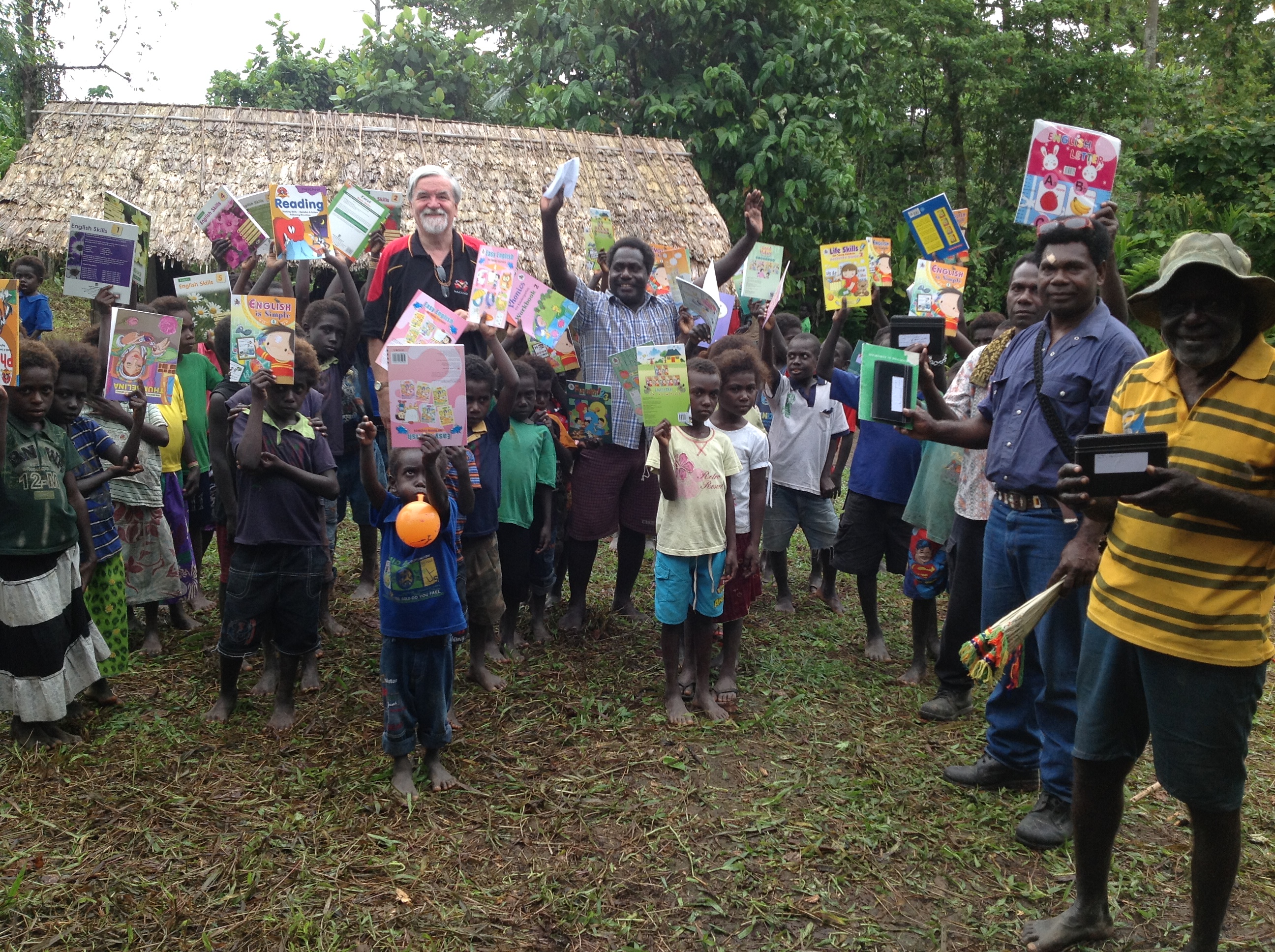
An Australian man, so affected by a trip to bring e-readers to students in a remote Panguna village, has launched an initiative to improve literacy throughout Bougainville.

Colin Cowell started the Book-Gain-Ville project in Australia with the support and guidance of the Indigenous Reading Project.

Cowell’s original visit with 20 kindles was to the Narinai Elementary School in the Panguna District, the home of former Bougainville president Mr. James Tanis. Here the Book-Gain-Ville project was launched and welcomed to the community with dancing, singing, speeches and slaughtering of two pigs to mark the importance of the occasion.

“Travelling around I saw broader need across the whole island, so we have added ten more sites for trial of the Book-Gain-Ville initiative,” Mr Cowell said.

“By the end of June 2014 we hope to have over fifty kindles in ten pilot schools and over the next few years I would like to see over one thousand kindles in Bougainville schools with the support of all the local level governments.”

Cowell, who hails from Canberra, Australia, has 24 years of experience working with and training Aboriginal communities across Australia and stated that the key to the Book-Gain-Ville project is sustainability.

251-colin-cowell

“We now have in place at the Arawa Women’s Training Centre the support technology and trained staff to take this project forward in years to come,” Cowell said.

“Guiding this project on the ground is a leadership group lead by James Tanis and group of teachers and IT volunteers.”

“The Kindles with up to 1400 books inside cost $99.00 and a lot of communities including the pilot sites have already begun fundraising to buy extra kindle on top of our donations.”

Update 11 July 2014

We are packing another 40 Kindles in Canberra to send to Bougainville on Monday 14 July

kindles

Colin Cowell is no stranger to Bougainville having lived there some 40 years ago and return he spent the whole month of May travelling the length and breadth of the island.

He met his old friends like Linus kunokong from Buin and visited cultural shows in Siwai, South Bougainville; visited tourism development sites across the island and even participated in the Bougainville Remembrance Day, May 17, in Arawa.

He will be returning soon to Bougainville with more kindles In September after shipping in July (see above)

More information about the project is available at www.bookgainville.com


Bookgainville  Project on Bougainville PNG


Bougainville News : President Momis to PNG Government “show me our money”


M O

The Panguna Mine funded PNG’s development from 1972 to 1989. Now, at the Peace talks, the PNG Government agreed to fund Bougainville’s restoration through a guaranteed share of PNG’s development budget,” President Momis said

Financing the Autonomous Bougainville Government according to the Bougainville Peace Agreement and the PNG constitutional laws is not a new program or an option for the National Government.

ABG President Chief Dr John Momis made this bold statement during the Joint Supervisory Board Meeting in Kokopo last Friday as he pointed out the National Government’s lax attitude in funding the ABG’s Restoration Development Grant.

“My Cabinet and I are getting more and more annoyed when we hear National Government officers and sometimes minister speaking of Bougainville’s requests for funding of the RDG as though these are new claims,” the President said.

“Our government’s entitlements are written into the Constitution of Papua New Guinea. Each government may share some blame for not getting this right from 2005, but that does make the provisions any less relevant,” he added.

When the Bougainville Peace Agreement was being negotiated the National Government’s finances were in a poor state and the National Government argued it could not afford to provide the massive sums needed to fund recurrent costs adequately and to restore infrastructure and service in Bougainville in what is now known as the Restoration and Development Grant.

The National Government team offered the Bougainville parties the rolling five-year average formula based upon the 2001 National Public Investment Program.

Their argument was that as Papua New Guinea’s economy improved Bougainville would benefit in the same proportion as the rest of the country, in other words the proportion of the National Development Budget would remain roughly the same as it was in 2001 and the rationale was primarily based around a concept of fairness.

“The Panguna Mine funded PNG’s development from 1972 to 1989. Now, at the Peace talks, the PNG Government agreed to fund Bougainville’s restoration through a guaranteed share of PNG’s development budget,” President Momis said

Under the RDG;s formulae proposed by the ABG’s share of the domestically financed Public Investment Programme will be around two percent but the formulae proposed by the National Government Bougainville’s share of the Development Budget will reduce dramatically to one third of the share it was in 2001.

Since the creation of Bougainville’s autonomous arrangement the RDG has remain stagnant at K15 m per year.
The President asked that the JSB seek to agree the RDG formulae and that the ABG want the 2015 paid at the correct rate to maintain services in Bougainville.

He also recommended that the respective Chief Secretaries of both governments sit down and agree on the appointment of a suitable mediator and arbitrator

Bougainville News: President Momis proposes new arrangement for engagement with PNG Government

 JM PO

Reported by Anthony Kaybing : New Dawn FM Bougainville News :Picture above PNG Prime Minister on recent visit to Bougainville

The Autonomous Bougainville Government has called for the abolishment of the National Coordination Office of Bougainville Affairs (NCOBA).

The ABG made a proposal last year that NCOBA and its roles and functions should be reviewed and a joint review on Bougainville’s Autonomy Arrangements, now endorsed by both the ABG and National Government also recommended this.

The ABG is of the view that NCOBA should be replaced with a different entity that can better coordinate the efforts of the Bougainville’s state of affairs while also acting as a go-between the ABG and the National Government.

A proposed idea is that a Bougainville Government representative office be based in Waigani and to be managed by a Director and staffed by Bougainville public servants to undertake coordination and advocacy with the National Government its departments and agencies.

Another option that was raised was the creation of A Bougainville Affairs Ministry, unlike the present ministry that is aligned to NCOBA or there could be a small Bougainville Affairs office within the Department of the Prime Minister and National Executive Council (Policy Division).

ABG President Chief Dr John Momis believes that the proposed arrangements can manage its engagement with all National Government departments and agencies and work effectively and efficiently.

The current state in which NCOBA operates has come into question due to the fact that it has not been as effective and efficient as the ABG and bureaucracy along with the people can see fit.

During the JSB Meeting of this year in Kokopo, the ABG has asked the National Government that the entity be disbanded and allow for the creation of a new entity that will have both influence of governments and allow for clear liaisons between the two governments.

New Dawn FM understands that the best time NCOBA was seen as working was under the former Director, BILL DIM who is now in New Zealand.

join-1


SUBSCRIBE TO BOUGAINVILLE NEWS TODAY


Bougainville News: Does the PNG Government currently owe the Autonomous Bougainville Government over K200 million ?

PM PNG
 

The PNG government will continue to honour its commitment in releasing K100 million annually for the remaining four years.

The national government in 2012 made a commitment to allocate K500 million over a five-year period, to rehabilitate infrastructure throughout Bougainville.

However, despite the first K100 million funding being released, last year (2013), nothing much has been done there,”

PNG Prime Minister Hon. Peter O’Neill said in a recent radio interview (see below)(picture above traditional welcome to Bougainville February 2014)

The Papua New Guinea National Government currently owes the Autonomous Bougainville Government over K200 million under the Restoration Development Grants.

This was revealed this week (30 June 2014) by the ABG president Chief Dr John Momis during the opening of a double classroom at Tilowa Primary School when he was talking about the transfer of powers to the Council of Elders

He told the people who gathered for that special occasion that this money under the Bougainville Peace Agreement belongs to Bougainville but the National Government was underpaying us.

He said after calculations were made, ABG found out that the National Government owes us over K200 million.

The president said if ABG gets that money, they will then look at ways to help the Council of Elders

in terms of increasing their funds.

He explained that in this way, the Council of Elders will be empowered to look after their own law and order issues, education

Prime Minister Peter O’Neill today (6/02/14) expressed the National Government’s gratitude towards the leaders and people of Bougainville for their kind welcome and generous hospitality, during his delegation’s recent visit to the region.

He said this during an interview on the FM100 Talkback Show, in Port Moresby and outlined the government’s commitment to assist Bougainville with infrastructure rehabilitation funding.

“The government will continue to honour its commitment in releasing K100 million annually for the remaining four years.

“The national government in 2012 made a commitment to allocate K500 million over a five-year period, to rehabilitate infrastructure throughout Bougainville.

“However, despite the first K100 million funding being released, last year (2013), nothing much has been done there,” Prime Minister Hon. Peter O’Neill said.

The Prime Minister said the monetary allocation was committed entirely to rehabilitate the rundown infrastructure throughout the region.

He also said the funding allocated last year was given to the Autonomous Bougainville Government (ABG) and it is solely responsible for acquitting the funds.

“There are also Special Resolution Grants sitting in trust accounts that need to be spent on upgrading infrastructure there,” Prime Minister Hon. Peter O’Neill said.

He said with the history of the crisis and loss of lives it was important for the national government to go back and engage with the people of Bougainville and apologize traditionally for all the hardship created, not only for Bougainville but for PNG as well. “I believe these issues could have been better managed before it got out of hand.

“It has been an eye-opening experience for a national government delegation which I led into the region recently,” Prime Minister O’Neill said.

He thanked the ABG, particularly President Chief Dr John Momis and his Cabinet, along with the four MPs of Bougainville for their partnership and dedication in putting aside their differences and working together to move Bougainville forward.

“I also met with the President of the Me’ekamui Government, Philip Miriori, and other leaders including the Panguna landowners like Laurence Daveona and Sam Kaona,” Prime Minister O’Neill said.

The Prime Minister reiterated that the government still respects the Arawa Peace Agreement signed in 2001 and looks forward to implementing it. “Our aim of going to Bougainville was to try and restore government services in the region.

“We want our hospitals to be functioning well in Bougainville, the roads upgraded and sealed, and the Aropa Airport reopened,” the Prime Minister said.

“The government has already opened the Port in Kieta and has re-established PNG Power to distribute power throughout Arawa town,” Prime Minister Hon. Peter O’Neill announced.

The president of the autonomous Papua New Guinea province of Bougainville, John Momis, says his government is considering suing the national government for what he says is its failure to meet the terms of the Peace Agreement.(Interview July 2013)

He says the lack of money is stalling preparations for the referendum on possible independence, which is a key part of the Bougainville Peace Agreement.

That vote is likely in 2016 and Mr Momis told Don Wiseman Bougainvilleans need to be more self reliant or seek financial help elsewhere if the national government does not meet its commitments.

JOHN MOMIS: The people of Bougainville must realise that that event, that important political moment in the history of Bougainville is quite imminent. As a matter of fact, next year the ABG, their own house of representatives, will determine the actual date of the referendum. So whilst we’re experiencing a lot of problems in respect to assistance from the national government, we need to get ourselves organised and be more self-reliant, even in terms of sourcing funds from outside. Because we are not having a very successful engagement with the national government. They seem to be having no qualms or conscience and consistently breaching the Bougainville Peace Agreement. So the only way to motivate our people is to say, look, we have to be ready. It’s like saying the grand final date is on, and, whether we are ready or not, we have to play in the grand final. We made the commitment so we better get ourselves organised.

DON WISEMAN: When you say that the national government is breaching the peace agreement, there was a lot of good feeling toward the end of last year and the government came through with those very large commitments they had made. So are you suggesting there’s been a backtracking since then?

JM: There’s been quite a bit of backtracking, yes. Even last year the $100 million the government promised only came to us in November towards the end of the year. It doesn’t give us much time to implement, especially when the Bougainville administration doesn’t have the capacity. And this year, we haven’t go this year’s allocation yet. And the restoration and development grant, which is stipulated in the Bougainville Peace Agreement, which is sub-constitutionally guaranteeing the allocation of funds which should be given to us every year – they have been under paying us deliberately. We worked out that, in fact, the national government owes us something like approximately $188 million. That is the only guaranteed funding to Bougainville. They’ve been severely underpaying us.

DW: And that’s separate from the commitment of 500 million kina that was made?

JM: Yes, 500 million for the next five years – that’s a political commitment the national government made. Whereas the restoration and development grant is constitutionally stipulated. The national government has no choice but to give it. In fact, we are seriously thinking of taking them to court for such a massive breach, which creates a lot of doubt in the minds of Bougainvilleans about the national government’s goodwill


Bougainville NEWS: Environment group offers $9m for biodiversity projects

 
Solomon Island farmers
Photo: Solomon Islands has some of the best examples of biodiversity in the Pacific (Wade Fairley: Flickr)
An environmental group is offering $US9 million in grants to help non-government organisations fund projects in Solomon Islands, Vanuatu and Papua New Guinea.
map_of_emi_1_141513

The International Union for Conservation of Nature says it wants to fund work that will protect biodiversity in the region.

The CEPF investment strategy for the East Melanesian Islands Hotspot has five strategic directions:

  1. Empower local communities to protect and manage globally significant biodiversity at priority key biodiversity areas underserved by current conservation efforts.
  2. Integrate biodiversity conservation into local land-use and development planning.
  3. Safeguard priority globally threatened species by addressing major threats and information gaps.
  4. Increase local, national and regional capacity to conserve biodiversity through catalyzing civil society partnerships.
  5. Provide strategic leadership and effective coordination of conservation investment through a regional implementation team

HOW TO APPLY LINK HERE

The IUCN’s Luisa Tagicakibau says there are countless habitats that need protecting and is calling for groups to submit proposals.

“These islands are highly biodiverse and hold exceptional cultural and linguistic diversity,” she told Pacific Beat.

“There are so many threats to these biodiversities, which are human induced and include increasing population, lack of awareness, unsustainable economic development.”

The IUCN is targeting 20 key biodiversity areas covering 1.5 million hectares.

“There are so many cultural and linguistic diversities at play in this region and because only a few people are speaking certain languages, they’re fast disappearing,” Ms Tagicakibau said.

“And that’s often leading to an increasing erosion of traditional knowledge and practices. These people are the real stewards of biodiversity.”

The money is being provided by the Critical Ecosystem Partnership Fund, which is a collaboration of seven different bodies including the European Union, the Japanese and French governments and the World Bank.

The IUCN says groups have until August 26 to submit proposals for funding.

Keep in touch with Bougainville

and funding opportunities SUBCRIBE FOR FREE

join-1

BOUGAINVILLE NEWS LINK


Bougainville Education News: Bougainville teachers receive TOT training


Book Gain Ville School

 Bougainville school at Narinia Nagovesi SEE LINK

FROM PNG EDUCATION NEWS

THE Bougainville Education Department, in its effort to make schools have their own Behavioral Management Policy (SBMP), has undertaken the task of training teachers to document their own policies.

The Department has already given Training of Trainers (TOT) to elementary and primary school head teachers, their board of management chairman’s and village chiefs of Selau and Suir constituencies in North Bougainville.

The policy is to act as a guideline to promote a caring, safe and healthy environment for the purpose of improving students learning inside the school and within the community.

Last week saw another TOT training being conducted at Tekokni primary school in Suir which was attended by 43 participants from the area.

The training was facilitated by Education Standard Officer, Mr Felix Sarimu, Guidance officer, Josephine Passingan and District Education Officer Mr. Ignatius Veromboe.

Mrs Passingan said the purpose of involving the chiefs, BOM and teachers is because there is a need for wider consultation to document the SBMP.

Acting Secretary of Bougainville Education Department, Mr Michael Meten, who attended the closing of the workshop last Thursday said the same problems that a child has in school is also being faced in the community.

“With the increase in number of students because of the tuition fee free education by the O’Neill/Dion Government, teachers now have a big responsibility to deal with,’ he said.

“Family problems also affects the child and teachers and the BOM must need to deal with that particular child and they must also deal with bullying, alcohol, smoking and chewing of betelnut in bigger students.’’

Mr Meten pointed out that every school needs to develop a policy to guide behavior in school and to help create a conducive environment for students, before adding that the policy will now be part of the Schools Learning Improvement (SLIP).

This week will see the participants from these two constituencies imparting on the training to their counterpart teachers during their in-service week and after that they must complete their documentation of the SBMP for launching on October this year.

join-1

DONATE HERE

Bookgainville  Project on Bougainville PNG


Bougainville News Alert : Push for late 2020 Bougainville PNG referendum ?

Radio New Zealand  and RADIO Australia are reporting  that an advisor to the autonomous Bougainville government says Papua New Guinea’s national leaders will likely set the date for the Bougainville referendum on independence.

LISTEN RADIO Australia Interview

regaa_psc

Anthony Regan  (pictured above) says there’s been relatively little focus among PNG’s national politicians on the approaching window for the referendum, which is to be held between 2015 and 2020.

“And as that date has to be agreed between the two sides, Papua New Guinea can effectively set the date as late as it likes up until 2020 so I think there’s a sense in Port Moresby that that’s probably what will happen. Although Bougainville can of course request an earlier date, it’s most likely that it’s going to be late.”

Anthony Regan was in New Zealand last week to give a lecture on Bougainville at Victoria University.

He says as Bougainville moves into this critical phase, there will be a need for considerable help from the international community over the range of complex issues that need to be negotiated with PNG in this phase

You can subscribe to these Bougainville News alerts


join-1

Bougainville news


Bougainville News: President questions if Bougainville ready for referendum: Mining law update

M O

By Anthony Kaybing

A recent statement by the Autonomous Bougainville Government President Chief Dr John Momis on Bougainville’s readiness to hold its referendum to decide its political fate has come into question. President Momis had stated earlier that Bougainville in its current state was not ready to hold its referendum due to insurmountable socio-political factors affecting the region at present.

SEE also below: A DRAFT mining bill transferring powers from the Papua New Guinea Government to the Autonomous Bougainville Government (ABG) could “adversely affect” the mining rights held by Bougainville Copper, the company has warned.

Public outcry over the President’s blunt statement has questioned his intentions on the determination of Bougainville’s future to the extent of also questioning his loyalty to Bougainville.

But he explained the reason for his outburst that Bougainville has to meet a certain criteria to ascertain its future to attain higher autonomy or move toward total secession and gain independence from Papua New Guinea.

“This is a fact and we cannot continue to disregard this, it’s a reality and we must man up and face it and do something about it if we really do care about the future of Bougainville,” he said.

The Bougainville Peace Agreement exudes President Momis’ concern on holding the referendum at a time when Bougainville has not yet quite met the expectations of the BPA on good governance and total weapons disposal.

The President pointed out that Bougainville is yet to achieve fiscal self-reliance, weapons disposal and the lack of unity amongst Bougainvilleans are the prime cause of his concern on holding the referendum too early which may prove detrimental.

“We cannot hold the referendum right now because we have yet not met the criteria of the Bougainville Peace Agreement and might I remind you, the outcome of the referendum depends on the ratification by the National Government so we will definitely fail should we do so right now,” the President said.

“You cannot have a nation when you don’t support your government, you can’t have a nation when there is disunity and law and order problems and you simply cannot have nation with a minimal educated populace,” the President also explained.

“When I say this it does not mean that we will not have the referendum or that I am against it, we will certainly have it but at a time within the ten year Referendum period and at a more suitable time when the government is ready so we should not make haste,” he said.
Having explained this the President also said that the Autonomous Bougainville Government has been working tirelessly to ready Bougainville for the ensuing Referendum period which must and only be held anytime between 2015 and 2020. This has been evident with the ABG legislating laws to strengthen its autonomy institutions to create a more conducive environment that is on par with international best practice on good governance.

 From Alison Middleton PNG Industry report June 27

bouganville_2009_10

A DRAFT mining bill transferring powers from the Papua New Guinea Government to the Autonomous Bougainville Government (ABG) could “adversely affect” the mining rights held by Bougainville Copper, the company has warned.

Bougainville Copper confirmed it had been provided with a Draft Bougainville Mining (Transitional Arrangements) Bill by the ABG.

The company said the bill appeared to be in accordance with the ABG’s stated objective to draw down powers from the PNG national government and obtain the transfer of powers relating to mining.

Bougainville Copper holds a number of resource tenements in Bougainville, including a special mining lease, various leases for mining purposes and several exploration licences.

The Rio Tinto subsidiary has been eyeing a resumption of mining of the giant Panguna copper deposit in the early 2020s, after the mine was closed in 1989 due to civil war.

“The SML entitles the company to explore and mine for copper within the SML area,” Bougainville Copper said in a statement.

“The SML is governed by the Bougainville Copper Agreement (BCA) and the Mining (Bougainville Copper Agreement) Act.

“The draft bill, in its current form, if passed into law, may adversely impact on the mining rights held by Bougainville Copper.

“The draft bill purports to repeal the BCA Act. The company does not concede the draft bill – if passed into law in its current form – does or can have that effect.

“Bougainville Copper is taking appropriate advice regarding the bill as drafted and will seek to liaise and meet with representatives of the ABG to discuss its concerns.”

You can now get the Bougainville News sent direct to your PC, Iphone or Ipdad

join-1


SUBSCRIBE HERE


Bougainville News: Australian Government discusses future of Bougainville in Senate Estimates

Pm

Papua New Guinea PM Peter O’Neill visits Bougainville in January 2014 as countries seek reconciliation following civil war

The following is a transcript from the Commonwealth of Australia Foreign Affairs Senate Estimates: Canberra June 2014

SUMMARY

Under the Bougainville peace agreement, to which Australia was a witness, the signatory is the central government in Papua New Guinea and the established Autonomous Bougainville Government. They agreed to a referendum window of 2015 to 2020 for there to be a question or questions put to the people of Bougainville about the future status of that province. One of those questions has to address the issue of possible independence for Bougainville. The Bougainville authorities, the Autonomous Bougainville Government and the authorities in Port Moresby, the Papua New Guinea National Government led by Prime Minister O’Neill, have been in discussions with each other. Those discussions have waxed and waned. I think we have noticed recently, as we get closer to the opening of that referendum window, that there has been some new positive and very welcome, from our point of view, momentum behind those consultations.

Those consultations, obviously, involve a range of players both from Bougainville and the central government, including the three Bougainville representatives who sit in the National Parliament in Port Moresby. The leader from the Bougainville side is the leader of the Autonomous Bougainville Government, Mr Momis. There are in the Bougainville peace agreement references to a number of things that should happen as we approach the referendum window. I emphasise there is no certainty on dates within that quite wide five-year window.

The question of timing for a referendum is one under the agreement that needs to be settled between the National Government of Papua New Guinea and the Autonomous Bougainville Government. Similarly, the conditions and arrangements for that referendum have to be settled in that way.

Our aid program in Bougainville is increasing as well as part of our broader aid program to Papua New Guinea. Minister Bishop is determined, as we approach 2015-2020, to use the aid program further in support of creating the conditions for future stability in that province and future prosperity for the people of Bougainville


Senator RHIANNON: Thank you, Chair. In 2013, USAID issued its Bougainville stability desk study and issued warnings about instability with regard to Bougainville. In 2008, there was an AusAID report called Market chain development in peace building: Australia’s roads, wharves and agriculture projects in post-conflict Bougainville that also warned that re-opening the Panguna mine on Bougainville was a high risk operation that could generate significant instability. Does the department accept this view? What is the current position with regard to reopening the mine?

Ms Klugman: I will just get to the right notes. Your question mentioned agriculture and a few other things and stability, but your question was about the future of the Panguna mine. You should rest assured, Senator, that both sides of the debate on the future of Bougainville—that is, the sovereign government of Papua New Guinea as well as the autonomous province of Bougainville—are fully aware of the role that both land and other issues around the Panguna mine played in the troubles. They are very focused on the future of that mine.

The future of the Panguna mine is quite clearly a matter for the government of Papua New Guinea through its arrangements with the autonomous Bougainville government, the resource sector being one of the areas of autonomous power being drawn by the autonomous Bougainville government under the Bougainville peace agreements.

Senator RHIANNON: So do I take from that that the Australian government does not have a position if it should be re-opened or do you have a position if it would be beneficial to Bougainville and PNG if the mine re-opened?

Ms Klugman: That is a matter for PNG and Bougainville.

Senator RHIANNON: Is the department aware of allegations in the British Journal of Criminology, volume 52, issue No 4, page 705: ‘Testimony from senior Australian Government officials is presented which strongly suggests the Australian Government supported PNG defence force operations on Bougainville during 1989 to 1992 and to that end provided direct military assistance, including ADF officers who helped plan the counter insurgency campaign.’ Is the department aware of these allegations and has any follow-up occurred since that article was printed?

Ms Klugman: I am not aware of that article. I am happy to take that question on notice.

Senator RHIANNON: Thank you.

Senator Brandis: I am not aware that the department of foreign affairs regularly subscribes to the British Journal of Criminology.

Senator RHIANNON: Senator, you are aware that was my question. But as it involves Australian government officials who were named as being quite senior, I thought it may have come to their attention. I am happy for it to go on notice.

Senator Brandis: Who was the author of the article?

Senator RHIANNON: You will be able to find all that out. I have not got much time; so I would like to move on.

Senator Brandis: You just cannot come in here and without—

Senator RHIANNON: Last night you told me I could not ask questions. Now you are saying I cannot come in here.

Senator Brandis: If I may finish, please, without being interrupted. You cannot just come in here and quote from an article that nobody has ever heard of and which has no bearing upon the work of DFAT and when you are asked to identify the author, decline to do so. These are serious allegations made against Australian personnel in the area and you will not cite your source.

Senator RHIANNON: This is the opportunity to clear the air.

Senator Brandis: You are the person who has raised the scandalous allegation.

Senator RHIANNON: Surely that is what estimates is about.

Senator Brandis: You will not even identify your source.

Senator RHIANNON: I have identified the source and I gave it to you right down to the page number.

Senator Brandis: Who was the author of the article?

Senator RHIANNON: I am happy to put it on notice later, the whole article.

Senator Brandis: So you have made a scandalous allegation against members of the ADF.

Senator RHIANNON: No, I have not made a scandalous allegation. I have repeated something. So you are saying—

Senator Brandis: You won’t even tell us who was making the allegation.

Senator RHIANNON: That it is not a reputable source?

Senator Brandis: It may not be a reputable source. It may not be a reputable person.

Senator RHIANNON: Again it is your time-wasting exercises.

Senator Brandis: Until we know who was the author of the article, how can we make a judgment about its reputability?


Senator RHIANNON: A freedom of information request was lodged by the Corporate Responsibility Coalition in Britain. It appears that the Australian government, from the information that was released, joined with their British counterparts to lodge an amicus curiae brief in support of Rio Tinto after it was sued under the alien tort statute for human rights abuses on Bougainville. Given this helped to block victims of war crimes from obtaining a potential remedy in the US courts, can the department explain why the Australian government decided to oppose the legal action?


Senator Brandis: Again, this question is even more foolish because your question is based on an assertion. It appears—from whom?

Senator RHIANNON: No, it is from a freedom of information—

Senator Brandis: From?

Senator RHIANNON: The Corporate Responsibility Coalition in Britain put it in. It is there on notice.

Senator Brandis: So someone—

Senator RHIANNON: Again, it is an opportunity to clear the air. What is wrong with that?

Senator Brandis: So some lobby group in a foreign country of whom nobody has ever heard has put in a freedom of information request. On that extremely slender basis, you are making allegations against the Australian government. What is your source?

Senator RHIANNON: Ms Klugman, will you take that on notice, please?

Senator Brandis: No, we will not take that on notice.

Senator RHIANNON: You will not even take it on notice?

Senator Brandis: We will not even take it on notice. We will not dignify it with a response because it is absurd.

Senator RHIANNON: Thank you, Chair. It says it all, coming from the minister.

Senator FAWCETT: Can I just follow up on Bougainville since we are on that topic. Ms Klugman, I am assuming you are probably the one to ask. You are obviously aware of that peace agreement which led to the understanding that there could be a referendum on independence between 2015 at the earliest and 2020 at the latest.

Ms Klugman: That is correct.


Senator FAWCETT: Could you update the committee on where we believe that sentiment is at in terms of desire for it and particularly a couple of the requirements that are being discussed? One is weapons disposal, particularly from the BRA, and also requirements for better governance before we move down that path.


Ms Klugman: Yes, you are quite correct. Under the Bougainville peace agreement, to which Australia was a witness, the signatory is the central government in Papua New Guinea and the established Autonomous Bougainville Government. They agreed to a referendum window of 2015 to 2020 for there to be a question or questions put to the people of Bougainville about the future status of that province. One of those questions has to address the issue of possible independence for Bougainville. The Bougainville authorities, the Autonomous Bougainville Government and the authorities in Port Moresby, the Papua New Guinea National Government led by Prime Minister O’Neill, have been in discussions with each other. Those discussions have waxed and waned. I think we have noticed recently, as we get closer to the opening of that referendum window, that there has been some new positive and very welcome, from our point of view, momentum behind those consultations.

Those consultations, obviously, involve a range of players both from Bougainville and the central government, including the three Bougainville representatives who sit in the National Parliament in Port Moresby. The leader from the Bougainville side is the leader of the Autonomous Bougainville Government, Mr Momis. There are in the Bougainville peace agreement references to a number of things that should happen as we approach the referendum window. I emphasise there is no certainty on dates within that quite wide five-year window.

The question of timing for a referendum is one under the agreement that needs to be settled between the National Government of Papua New Guinea and the Autonomous Bougainville Government. Similarly, the conditions and arrangements for that referendum have to be settled in that way.

I referred to some new momentum. I think I had focused in particular on a visit that was made two months ago to Bougainville by Prime Minister O’Neill himself. That was the first visit by Prime Minister O’Neill to that province. Indeed it was the first time a Papua New Guinea Prime Minister had been to Bougainville for many years. There were some reconciliation ceremonies and events that preceded that visit, which are important in the context of the history of the conflict in that place.

For our part, Australia, as a neighbour, as a close friend of Papua New Guinea and, by the way, as a witness to that peace agreement, have been stepping up, through Ms Bishop our dialogue with the leadership in Papua New Guinea on those questions, the questions of referendum, the questions of Australian assistance with economic development activities in Bougainville as part of our broader aid program in Papua New Guinea.

I think we are in a phase, I would say, of stepped-up interaction and dialogue with the two principal players in this matter, which are the government of Papua New Guinea and the government of that autonomous province.


Senator FAWCETT: I guess my question goes to the issues that were the pre-enabling conditions, which were the governance and the weapons cell. Given the consequences for Australia of instability in Bougainville should things not go well, I am just interested: are we committing resources in terms of people or funding to assist with those two particular elements around increasing governance or monitoring or facilitating weapons control

Ms Klugman: Yes, we are doing both of those things. You mentioned two issues which are prominent in the agreement itself. In the letter of the agreement, they are not conditions for a referendum but they are very much pre-conditions for a referendum but they are important conditions for a successful and peaceful act of successful and peaceful referendum in that country.

There is still a lot of ordnance left over. You mentioned the weapons disposal but there is also a lot of UXO disposal which we have been involved in, in particular through the role of the Australian Defence Force in Operation Render Safe, which is an operation that goes beyond Papua New Guinea but there is a particular focus on Papua New Guinea. Its purpose is to clean up damaging ordnance left over from the Second World War.

Our aid program in Bougainville is increasing as well as part of our broader aid program to Papua New Guinea. Minister Bishop is determined, as we approach 2015-2020, to use the aid program further in support of creating the conditions for future stability in that province and future prosperity for the people of Bougainville